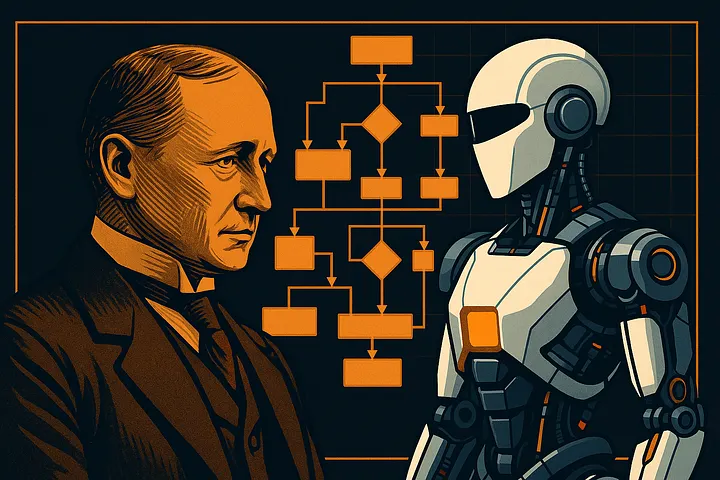
The New Scientific Management: Why the AI Era Needs an Organizer


From Workmen to Foremen
AI is everywhere. It writes. It codes. It designs. It even argues with you about philosophy at 2 a.m.
In other words, we’ve built the perfect digital workmen — tireless, fast, and always on cue. But here’s the irony: instead of becoming the leaders of these AI teams, we humans have turned into their foremen.
Day after day, we sit in front of our screens, prompting, re-prompting, tweaking, and micromanaging. We were supposed to be the bosses. Instead, we became the lubricant of the AI assembly line — trapped between tokens, tools, and tasks.
This isn’t the first time humanity has faced this problem. A century ago, during the rise of industrial factories, workers and managers struggled with the exact same dilemma. And the solution came from an unlikely source: scientific management.
A Short History of Scientific Management
At the end of the 19th century, factories were booming across the United States. Steam engines and industrial machinery promised unprecedented output. Yet, productivity lagged.
Why? Because while machines were standardized, human labor wasn’t.
- Two workers using the same lathe could produce wildly different results.
- Some workers deliberately slowed down (“soldiering”) to avoid being exploited.
- Management had no system for planning or measuring performance — only hunches and discipline.
The result was conflict. Labor and capital clashed. Productivity flatlined. Industrialization risked stalling.
Enter Frederick Winslow Taylor, a mechanical engineer obsessed with efficiency.
Taylor’s Big Idea
Taylor believed work could — and should — be studied scientifically. His approach was radical at the time:
-
Time and Motion Studies Break every job into the smallest tasks. Measure how long each takes. Identify the “one best way” to perform it.
-
Standardization Replace “rule of thumb” methods with precise, tested procedures.
-
Separation of Planning and Doing Managers plan and coordinate. Workers execute.
-
Incentives and Measurement Pay tied to output. Results measured, not assumed.
The impact was seismic. Productivity soared. Factories became predictable, scalable systems. Henry Ford’s assembly line was built on these principles, ushering in the modern industrial economy.
Of course, Taylorism had critics — it dehumanized workers, reduced individuality, and sparked labor resistance. But there’s no denying its transformative effect: it turned chaotic workshops into organized industrial powerhouses.
Today’s Parallel: The AI Factory
Fast-forward to 2025. We’re living through another industrial revolution, this time powered by AI.
- AI = the workmen. ChatGPT, Claude, MidJourney, dozens of specialized agents. They don’t tire. They don’t unionize. They just work.
- Humans = the foremen. We spend our time prompting, checking, editing, and patching together results.
The problem? We’ve recreated the 19th-century factory floor.
Just like back then, productivity is uneven:
- One person wrings gold from AI with clever prompting.
- Another gets nonsense or wastes hours tweaking.
- Teams struggle to coordinate multiple AI tools, databases, and workflows.
We have the workmen. What we don’t have is the management layer.
The Need for an AI Organizer
Here’s the truth: more AI agents won’t solve the problem. We don’t need 100 more workmen. We need a way to organize them.
Think of it as Taylorism for the AI era.
- Coordination: Multiple agents working in sync, not in silos.
- Delegation: Assigning the right tasks to the right AI, automatically.
- Oversight: Tracking workflows across tools, databases, and platforms.
- Standardization: Instead of ad-hoc prompting, repeatable processes and automations.
In short: humans as leaders, not micromanagers.
This is the vision behind the concept of an AI Organizer — the missing management layer of the AI revolution.
From Chatbots to Organizers: The Five Levels of AGI
If we zoom out, we can see a hierarchy emerging:
- Level 1: Chatbot — Basic Q&A.
- Level 2: Reasoner — Chains of thought, problem-solving.
- Level 3: Agent — Autonomy, goal-driven tasks.
- Level 4: Innovator — Creativity, ideation, generating new solutions.
- Level 5: Organizer — The conductor, orchestrating multiple agents, tools, and humans into a functioning organization.
Most of today’s AI tools are stuck around Level 2–3. Some experiments touch Level 4.
But the real leap — the equivalent of Taylor’s scientific management — is Level 5: Organizer.
That’s when AI stops being just workmen and starts becoming a management system.
Why It Matters
Without an Organizer, the AI revolution risks becoming… messy. We’ll drown in a sea of disconnected agents, apps, and prompts. Productivity will plateau.
With an Organizer, however:
- A solopreneur can run a company of 50 AIs as easily as chatting in a messenger.
- A freelancer can manage client projects like an agency — without hiring staff.
- A manager can combine AI and human teammates into one seamless workflow.
Just as Taylor’s stopwatch transformed factories, an AI Organizer could transform knowledge work.
The Human Side
Now, some may ask: aren’t we repeating Taylor’s mistake? Won’t “AI Taylorism” reduce humans to supervisors of machines?
The difference is this: in the AI era, humans set direction, AI executes. We’re not standardizing human effort — we’re standardizing digital labor.
Humans get to focus on vision, strategy, creativity, leadership. AI handles the repetitive, structured work.
This is the inversion of Taylorism. Instead of dehumanizing workers, it may finally liberate us from being mere workmen.
Conclusion: Building the Level-5 Future
When Frederick Taylor introduced scientific management, he didn’t just make factories efficient. He changed the way the world thought about work.
We’re at a similar inflection point today. AI has given us infinite digital labor.
What it hasn’t given us is organization.
That’s why we need a new scientific management — for the AI era. That’s why we need the AI Organizer.
Because the future of productivity isn’t just “more AI.” It’s organized AI.
The workmen are here. The factory is running. What we’re missing is the Organizer. That’s the story I’ll be exploring next. Stay tuned.
Recommend Reading
- Invoice Workflow Automation: How It Works, Key Benefits & Best Practices
- How Does Marketing Automation Work? A Step-by-Step Guide
- How to Automate Social Media Posting with AI: 2026 Strategy Guide
- How Is Agentic AI Different From Traditional Automation?
- Is AI Marketing Automation Affordable for Small Businesses?
Recommend AI Automation Templates