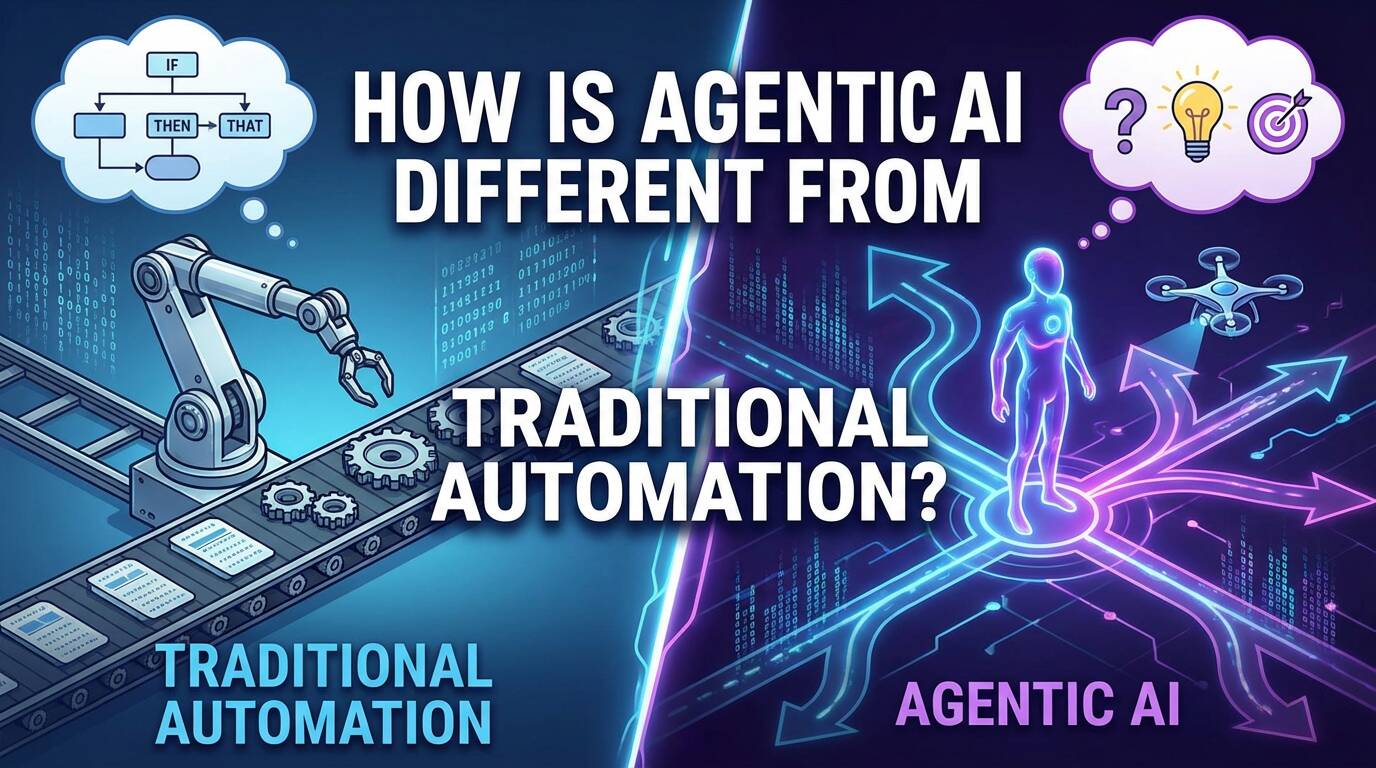
How Is Agentic AI Different From Traditional Automation?


Agentic AI doesn’t replace traditional automation—it extends it.
Traditional automation excels at predictable, rule-based work, while agentic AI is designed for dynamic environments where goals shift, data is messy, and judgment matters. The real difference lies in autonomy: agentic AI can plan, decide, act, and adapt toward outcomes, whereas traditional automation follows predefined rules exactly as written. Organizations that combine both approaches—not choose one over the other—are seeing the strongest results.
Platforms like Bika.ai put this hybrid approach into practice, combining rule-based automation with orchestrated agentic AI so teams can chat, build, and manage autonomous workflows in one unified system.

Understanding the Basics of Agentic AI and Traditional Automation
What Is Traditional Automation?
Traditional automation relies on explicit rules and predefined workflows. Whether implemented through RPA, workflow engines, or low-code tools, the logic is deterministic: if X happens, do Y.
This approach works best when:
- Processes are structured and repeatable
- Inputs are consistent
- Outcomes must be exact and auditable
Real-world experience: In finance and compliance-heavy operations, rule-based automation still delivers near‑zero error rates for tasks like reconciliations, approvals, and reporting. Its rigidity is a feature—not a flaw—when consistency matters more than flexibility.

What Is Agentic AI?
Agentic AI refers to goal-oriented AI systems that don’t just analyze data but act on it autonomously to achieve defined outcomes. These systems can:
- Set sub-goals
- Choose strategies
- Use tools and external data
- Adapt when conditions change
Unlike traditional AI models that respond only to prompts, agentic AI operates continuously, making decisions without constant human supervision.
Example: In supply chain operations, an agentic AI can reroute shipments in response to weather disruptions or economic shocks. Over a decade, supply chain disruptions can drain up to 50% of annual profits, making adaptive systems economically critical.
What Is Agentic AI Automation?
Agentic AI automation combines automation infrastructure with autonomous decision-making. Instead of automating a single task, it automates outcomes.
- Traditional automation: Execute steps
- Agentic AI automation: Achieve goals
This shift turns automation from a static workflow into a living system that learns and evolves.
Traditional Automation vs Agentic AI Automation: Key Differences

Agentic AI vs Traditional Automation
| Dimension | Traditional Automation | Agentic AI Automation |
|---|---|---|
| Logic | Fixed rules | Adaptive reasoning |
| Scope | Single tasks | Multi-step workflows |
| Change handling | Manual updates | Real-time adjustment |
| Decision-making | Deterministic | Probabilistic & contextual |
Rule-Based Automation vs Autonomous AI Agents
Rule-based systems require humans to anticipate every scenario in advance. Autonomous agents, by contrast, learn from new data and adjust behavior without being reprogrammed.
Task Automation vs Decision-Making AI
- Task automation focuses on efficiency
- Decision-making AI focuses on effectiveness
Agentic AI evaluates options, weighs trade-offs, and selects actions aligned with broader objectives.
Automation vs Autonomy
Automation executes instructions.
Autonomy chooses which instructions matter.
Why Agentic AI Automation Needs Orchestration
AI Orchestration Explained
Autonomy without coordination creates chaos. Orchestration defines:
- When agents act
- How they interact
- Where human oversight is required
Single-Agent vs Multi-Agent Systems
- Single-agent systems handle focused tasks
- Multi-agent systems divide complex problems into specialized roles, collaborating toward shared goals
This collaboration enables scalability but demands orchestration.
Coordination in Autonomous AI Workflows
Effective orchestration:
- Prevents duplicated work
- Aligns decisions across departments
- Creates feedback loops to humans for high-stakes judgment calls
Organizations that skip orchestration often see pilots stall at small scale.
Risks of Poor Orchestration
Without orchestration:
- Agents operate in silos
- Decisions conflict
- Accountability becomes unclear
Orchestration is not optional—it’s foundational.
What Makes Agentic AI Automation Different
Goal-Oriented Planning and Reasoning
Agentic AI doesn’t wait for instructions. It plans backward from desired outcomes, selecting actions dynamically.
Memory and Context Awareness
These systems retain:
- Historical actions
- Prior decisions
- Environmental context
This allows learning across cycles, not just within a single task.
Tool Use and System Integration
Agentic AI can:
- Query databases
- Trigger workflows
- Call APIs
- Generate artifacts (reports, documents, dashboards)
This turns AI from a thinker into a doer.
Feedback Loops and Adaptation
Continuous feedback allows agentic AI to refine strategies, improving performance over time rather than repeating static behavior.
Benefits of Agentic AI Automation for Businesses

Flexibility Beyond Static Workflows
Agentic AI adapts when:
- Inputs change
- Data quality varies
- Goals evolve mid-process
Reduced Human Intervention
Once objectives and guardrails are defined, agentic systems can operate with minimal supervision, escalating only when judgment is required.
Scalability Across Business Functions
From marketing to operations, the same agentic framework can support diverse workflows without rebuilding logic from scratch.
Outcome-Driven Automation
Success is measured by results, not task completion. This aligns automation directly with business value.
Agentic AI Automation Use Cases
Customer Support and Follow-Up
Agents can analyze incoming requests, draft responses, update documentation, and escalate edge cases—reducing response times while maintaining quality.
Sales and Revenue Operations
Agentic AI can prioritize leads, schedule follow-ups, and adjust outreach strategies based on engagement signals.
Marketing Automation
Instead of static campaigns, agentic systems adapt messaging and timing based on real-time performance data.
Software Development and DevOps
Agents can manage issue triage, summarize progress, and coordinate releases across tools and teams.
Knowledge Work and Research
Agentic AI can gather data, synthesize insights, and produce structured reports—freeing humans for higher-level thinking.
Blending Traditional Automation With Agentic AI

Hybrid Automation Models
The most effective systems use:
- Rule-based automation for stable processes
- Agentic AI for adaptive workflows
When Traditional Automation Works Better
Choose traditional automation when:
- Compliance is strict
- Processes rarely change
- Predictability outweighs flexibility
Transitioning to Agentic AI
Start small:
- Identify high-variance workflows
- Add autonomy incrementally
- Layer agentic capabilities on top of existing automation
Avoiding Over-Automation
Not every task needs intelligence. Overengineering increases cost without adding value.
Architecture Behind Agentic AI Automation
Agentic AI System Architecture
Core components include:
- Reasoning layer
- Memory layer
- Tool and integration layer
- Orchestration layer
LLMs, Tools, and Memory Layers
LLMs provide reasoning, tools enable action, and memory ensures continuity across time.
Workflow Engines vs Agent-Based Systems
Workflow engines follow scripts.
Agent-based systems design the script as they go.
Security and Reliability Considerations
Robust permissions, audit trails, and fallback mechanisms are essential to maintain trust.
Governance and Risk Management
Security Risks of Autonomous AI Agents
Autonomous action introduces risks if boundaries aren’t defined clearly.
Human-in-the-Loop vs Human-on-the-Loop
- Human-in-the-loop: Humans approve actions
- Human-on-the-loop: Humans monitor and intervene only when needed
Both are critical at different stages.
Compliance and Monitoring
Continuous logging and monitoring ensure decisions remain explainable and compliant.
Preventing Hallucinations and Runaway Agents
Guardrails, validation steps, and escalation rules keep autonomy under control.
How Leaders Can Prepare for Agentic AI Automation
Identifying the Right Use Cases
Focus on workflows that are:
- Data-heavy
- Exception-driven
- Outcome-oriented
Building a Strong Foundation
High-quality data, clear objectives, and staged rollouts are prerequisites.
Upskilling Teams
The shift is cultural. Teams must learn to collaborate with AI, not compete with it.
Measuring ROI
Track:
- Time saved
- Error reduction
- Decision quality
- Business outcomes
The Future of Agentic AI Automation
From Automation Tools to Autonomous Systems
We’re moving from task executors to digital coworkers.
Agent-First Platforms
Future platforms will be designed around agents, not workflows.
The Future of Work
Agentic AI becomes a second workforce—always on, continuously improving.
Take a Balanced Approach to Automation
Where Agentic AI Delivers Value
- Dynamic environments
- High-variance decision-making
- Multi-step, cross-functional workflows
Where Traditional Automation Still Wins
- Predictable processes
- Compliance-driven tasks
- High-volume, low-variance work
The competitive edge doesn’t come from choosing automation or autonomy—it comes from knowing how to blend them.
Recommend Reading
Recommend AI Automation Templates